Transformer基础架构详解(附图 + Python Demo)
·
一、为什么会有 Transformer?
在 Transformer 出现之前,主流模型是:
- RNN(循环神经网络)
- LSTM / GRU
import torch
import torch.nn as nn

# 定义RNN
rnn = nn.RNN(input_size=128, hidden_size=128)

# 输入:序列长度=5
x = torch.rand(5, 1, 128)

h = torch.zeros(1, 1, 128)  # 初始隐藏状态

outputs = []

for t in range(5):  # ❗必须逐时间步计算(串行)
    out, h = rnn(x[t].unsqueeze(0), h)
    outputs.append(out)

# outputs保存每个时间步结果
import torch
import torch.nn as nn

# 定义LSTM
lstm = nn.LSTM(input_size=128, hidden_size=128)

x = torch.rand(5, 1, 128)

h = torch.zeros(1, 1, 128)  # 隐藏状态
c = torch.zeros(1, 1, 128)  # 细胞状态(关键!)

outputs = []

for t in range(5):  # ❗仍然是串行
    out, (h, c) = lstm(x[t].unsqueeze(0), (h, c))
    outputs.append(out)
# 此处是trasnformer案例
import torch
import torch.nn as nn

# 多头注意力
attn = nn.MultiheadAttention(embed_dim=128, num_heads=8)

# 一次性输入整个序列
x = torch.rand(5, 1, 128)

# Q = K = V = x(自注意力)
output, weights = attn(x, x, x)
RNN和LSTM有两个致命问题:
- ❌ 无法并行计算(太慢)
- ❌ 长距离依赖难以捕捉
二、Transformer整体架构
二、整体架构(核心结构)
Input → Encoder → Decoder → Output
          ┌───────────────┐
Input →   │   Encoder × N │
          └───────────────┘
                    ↓
          ┌───────────────┐
Target →  │   Decoder × N │ → 输出
          └───────────────┘
三、Encoder 结构(重点)
每一层 Encoder 包含两个核心模块:
在 Transformer 中,Encoder 是负责“理解输入”的部分。
每一层 Encoder 都包含两个核心模块:
👉 Self-Attention(自注意力) + Feed Forward(前馈网络)
输入
 ↓
Multi-Head Self-Attention
 ↓
Add & LayerNorm
 ↓
Feed Forward Network
 ↓
Add & LayerNorm
 ↓
输出
1️⃣ Self-Attention(自注意力)
1. 本质作用:👉 让每个词都能“看”到句子中所有词,并决定关注谁
2. 举个直觉例子:The animal didn't cross the street because it was too tired
问题:“it”指谁?
- animal ❓
- street ❓
👉 Self-Attention 会自动学到:
“it”更关注“animal”
3. 数学计算过程(核心)
Step 1:生成 Q / K / V
输入向量 x 通过线性变换:
Q = xWq
K = xWk
V = xWv
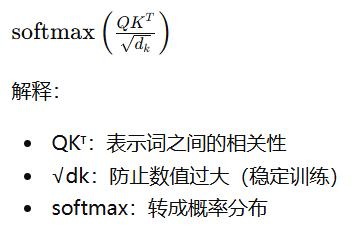
Step 2:计算注意力权重
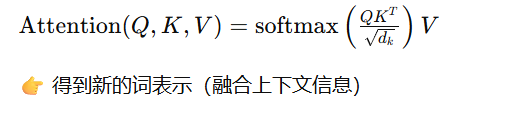
Step 3:加权求和
4. Multi-Head Attention(多头)
不是只做一次 Attention,而是:
Head1: 学语法关系
Head2: 学语义关系
Head3: 学位置关系
...
最后拼接:
Concat(head1, head2, ...) → Linear
👉 本质:
从多个“角度”理解句子
5. PyTorch 简化实现
import torch
import torch.nn.functional as F

def self_attention(x):
    d_model = x.size(-1)

    Wq = torch.rand(d_model, d_model)
    Wk = torch.rand(d_model, d_model)
    Wv = torch.rand(d_model, d_model)

    Q = x @ Wq
    K = x @ Wk
    V = x @ Wv

    scores = Q @ K.transpose(-2, -1) / (d_model ** 0.5)
    weights = F.softmax(scores, dim=-1)

    return weights @ V

x = torch.rand(1, 5, 64)
out = self_attention(x)
print(out.shape)
2️⃣ Feed Forward(前馈网络)
待完善...

这里是“一人公司”的成长家园。我们提供从产品曝光、技术变现到法律财税的全栈内容,并连接云服务、办公空间等稀缺资源,助你专注创造,无忧运营。
更多推荐


 10
10 0
0- 0


 已为社区贡献1条内容

所有评论(0)